How Ad Rem cracked black-plastic analysis and why UK plastic recyclers should take note…
Ad Rem’s new automated quality control system reads both the polymer type and the elemental make-up of every flake, including black plastics that conventional NIR analysers simply cannot see. As Ad Rem’s partner in the UK and Ireland, Allcontrols can help you put it to work.
If you recycle plastics, checking flake quality has always been a compromise. Do it properly and it is slow and manual: an operator picks up a single flake, places it on a detector, waits for a reading, then records the result by hand. Do it quickly using an automated near-infrared (NIR) analyser and you gain speed but lose accuracy, because NIR cannot read black plastic.
That black-plastic blind spot is the heart of the problem, and it is exactly what Ad Rem set out to solve with the OWL. Speaking about the system, Ad Rem Sales Engineer Jelle Saint-Germain explained how the company combined two technologies to read both what a flake is and what it contains.
Two proven sensors, one automated machine
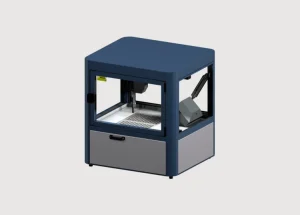
The OWL combines two established analysis techniques in a single automated unit. An FTIR spectrometer, a commercially available Thermo Fisher model, reads the infrared spectrum of each flake to determine the polymer type, for example PE, PP, PS or ABS. Alongside it, an XRF analyser, working much like a handheld X-ray scanner, determines the elemental composition and can detect more than 30 elements, including bromine, chlorine and antimony.
The clever part is that the OWL links both readings to the same individual flake. For every flake it can effectively say: this is this type of plastic, and it contains these elements in this amount. Results are visualised in real time at both flake and batch level, stored securely and exported whenever you need them. Because it relies on FTIR rather than NIR, it can also pick out fillers such as calcium carbonate, talc and glass fibre.
Operation is genuinely hands-off. You prepare your flakes once, a job of five or ten minutes, load them onto a tray, insert it and press start. The OWL works through roughly 100 flakes an hour, so a typical run of around 200 flakes takes about two hours, after which all the results are waiting for you. There is no feeding flakes in one at a time.
Why NIR misses black plastic, and the OWL does not
NIR works by reading the spectrum reflected from a flake. Black material absorbs that spectrum and reflects almost nothing back, so an NIR system cannot identify it. In practice it ends up analysing only the non-black flakes and extrapolating from there, which gives a distorted picture of the whole stream.
That matters because black plastic is rarely a small fraction. In Ad Rem’s own research on a mix of small domestic appliances, roughly half the flakes were black, and the make-up of those black flakes was very different from the rest. In one input stream, 12% of the material was polyamide, and that polyamide was entirely black. An NIR analyser would not have registered it at all.
“That is a blind spot, literally, which we fix by using FTIR instead of near-infrared.”
Jelle Saint-Germain, Sales Engineer, Ad Rem
Because the OWL sees that black material, you can value incoming deliveries on the genuine composition of the mix rather than an estimate.
Catching bromine before it becomes a problem
Regulation sets a threshold for how much bromine is allowed in recycled plastic, and the rules around bromine and persistent organic pollutants (POPs) are tightening. The trouble with the usual approach is timing. Today a recycler typically compounds and extrudes the material, tests the finished product, and only then discovers it is over the limit, at which point the whole batch may need reprocessing. Detection happens after the fact.
The OWL flips that around. It identifies, flake by flake, exactly where the bromine is and how much there is, before extrusion. In a batch of 100 flakes it might be that only three contain bromine, but in a very high concentration. Spot those early and you can trace and remove the source, so the material you compound is already below the legal limit. For any recycler facing stricter POPs enforcement, that shift from testing after the fact to detecting before extrusion is significant.
Proven by research and coming to RWM in September
The OWL is not a prototype. It was developed through a research project involving the University of Leuven, VITO, Galloo and Ad Rem, with more than ten thousand plastic flake samples mapped and analysed over many months. Ad Rem, based in Menen in Belgium, is also building a test facility to push the recovery of both plastics and metals from shredder residues further. Buyers of the OWL receive a library of reference spectra for plastics from ASR and WEEE streams, so you can benchmark your own material against industry baselines from day one. The system is patent pending and already commercially available.
After showings at IERC in January and the PRSE 2026 trade fair in Amsterdam, Ad Rem will demonstrate the OWL at E-Waste World in Frankfurt in June 2026 and then at RWM in the UK in September 2026. If you would benefit from seeing it on home soil, RWM is your chance to watch the machine demonstrated.
Is the Owl what you are looking for?
As Ad Rem’s sole partner in the UK and Ireland, Allcontrols can help you work out whether the OWL fits your material streams and your quality control goals. We have spent more than 20 years helping UK recyclers improve productivity, raise yields and increase material stream purity, and the OWL is a natural addition to that toolkit.
To talk through the OWL, or to arrange to see it in action, call our Cambridge team on 01223 223900 or get in touch through our contact page.